Bull Call Spread vs. Bull Put Spread: Which is better?
Bull Call Spread or Bull Put Spread? Both strategies are bullish, but each one profits from a slightly different market scenario. Which is better when you expect a fast upside move, and which is better when your main idea is support holding with time decay?
Short answer:Bull Call Spread often makes more sense when you expect a stronger bullish move, while Bull Put Spread can be a better fit when you mainly expect a key price level to hold. Both are bullish strategies, but they behave differently around price movement and time decay.
What do they have in common?
Both Bull Call Spread and Bull Put Spread are bullish vertical spreads. In both cases:
maximum profit is capped,
maximum loss is limited,
they fit scenarios where you expect upward movement or support to hold.
The difference is not whether you are bullish. The difference is what kind of move you expect, how quickly it should happen, and whether time decay is your friend or your enemy.
Bull Call Spread
Type: debit spread.
You buy a call at a lower strike and sell a call at a higher strike with the same expiration. You pay a debit and generally benefit most when the underlying moves higher before too much time value decays.
useful when you expect a fast bullish breakout,
often fits failed-auction or structural-change scenarios,
profit is usually driven by price movement and changes in delta and gamma.
Time decay works against you here, so the move should happen relatively soon.
Bull Put Spread
Type: credit spread.
You sell a put at a higher strike and buy a put at a lower strike. You collect a credit and often profit when the market stays above the short put, even if the move is not dramatic.
useful when you expect support to hold,
does not require a large breakout,
theta can work in your favor if the market remains relatively stable.
This spread is often a better fit when you do not want to wait for a strong breakout and instead want to profit from price holding a key level.
Payoff, break-even, and risk
For both strategies, the main things to watch are the strike width, the entry price, the break-even level, the max profit, the max loss, and the time to expiration.
Implied volatility (IV) also matters. Higher IV generally increases option prices, which can affect the attractiveness and entry cost of both debit and credit spreads.
Bull Call Spread usually performs better when the underlying moves up quickly,
Bull Put Spread often works better when price stays near support and does not trigger a sharp breakout,
debit spreads can lose value if the market moves too slowly,
credit spreads can benefit from time decay if the price remains in a favorable range.
Simple examples
Example 1: Bull Call Spread
Buy 220 Call for $3.00
Sell 225 Call for $1.00
Net debit: $2.00
Maximum profit: $3.00 per share, or $300 per contract
Maximum loss: $2.00 per share, or $200 per contract
Break-even: 222
Example 2: Bull Put Spread
Sell 215 Put for $3.00
Buy 210 Put for $1.00
Net credit: $2.00
Maximum profit: $2.00 per share, or $200 per contract
Maximum loss: $3.00 per share, or $300 per contract
Break-even: 213
Side-by-side comparison
Topic
Bull Call Spread
Bull Put Spread
Strategy type
Debit spread
Credit spread
Initial cash flow
Pay premium
Receive premium
Best when
You expect a fast bullish move
You expect support to hold
Time decay
Usually negative
Usually positive
Break-even
Higher than the long strike
Below the short put
Which one should you choose?
Choose Bull Call Spread when:
you expect a strong directional move higher,
you expect the move to happen relatively soon,
you want positive exposure to price movement.
Choose Bull Put Spread when:
you expect support to hold,
you do not need a large upside move,
you want theta to work in your favor.
Quick rule: strong bullish move → Bull Call Spread. Support holds → Bull Put Spread.
A practical example from Optalyze
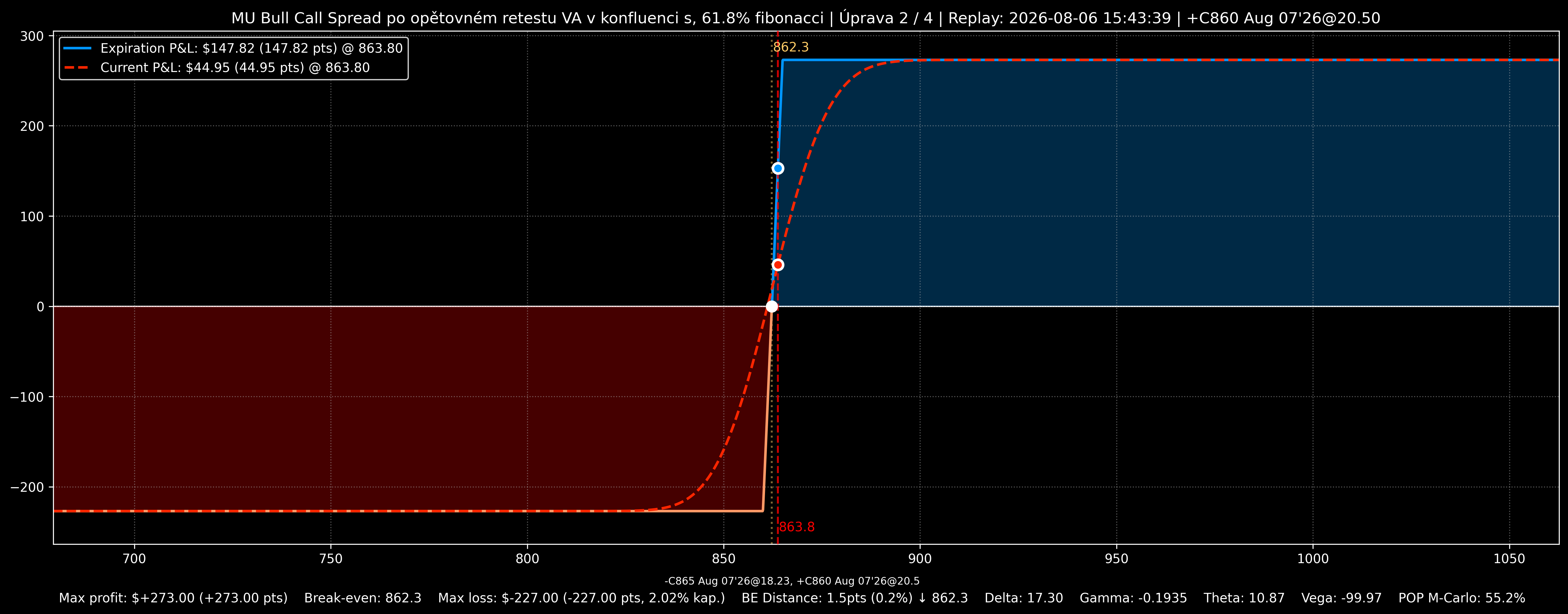
In Optalyze, you can compare the spread structure, break-even, max profit, max loss, and payoff profile before entering a trade. That makes it easier to decide whether a bullish setup fits a fast move higher or a more neutral hold-the-support scenario.
Real MU example in Optalyze: Bull Call Spread with predefined max risk, max profit, and a clear break-even level.
That is often the difference between choosing a setup based on a label and choosing one based on the actual market behavior you expect.
FAQ
Is a Bull Call Spread better than a Bull Put Spread?
No. The better choice depends on the expected move, the time horizon, volatility, and your risk profile.
Which is better for a fast bullish move?
A Bull Call Spread is often the more natural fit when you expect a strong move higher in a relatively short time.
Which strategy benefits from time decay?
A Bull Put Spread generally benefits from time decay, assuming the underlying stays within a favorable range.
Can both strategies lose money?
Yes. Both have defined maximum losses, but the loss can still be meaningful depending on the strikes and entry price.
Practical takeaway
There is no universally better strategy. There is only the strategy that fits your market scenario better.
When choosing between Bull Call Spread and Bull Put Spread, start with this question: “What kind of move do I expect?” Only then choose the spread structure.